
Research
With its professional infrastructural Units, FAU EAM is the base for a wide range of collaborative research projects. Additionally, New Materials and Process Research has been continously translated to a great number of ERC Grants. To foster young researchers in ther individual career and scientific independence, FAU EAM provides the EAM Starting Grant program, which lead to a number of sucessful ERC applications.
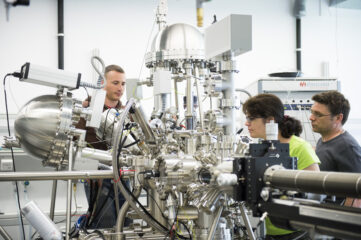
Running projects based on FAU EAM
CRC 1719
Semiconductor materials perform all the work in computers and cell phones, but also in solar cells and sensors of all kinds. In our new Collaborative Research Center 1719 ‘Next-generation printed semiconductors: Atomic-level engineering via molecular surface chemistry’ (ChemPrint) the scientists aim to revolutionize semiconductor manufacturing. We develop methods for the direct deposition of layers and the placement of patterns through the controlled deposition of individual atoms as an alternative approach to the traditional production of silicon components based on high-purity single crystals. We achieve this by selecting suitable molecular reagents programmed to deliver individual atoms to specific locations. In this respect, molecules behave as nanoscale robots that assemble parts in the workshop. Such methods offer many advantages. Firstly, they are highly energy-efficient and extremely economical of materials. Additionally, chemical control enables them to become technologically simple to implement. Thus, ChemPrint will broaden access to the production of semiconductor components and empower new actors to become active and creative in this field and to invent, be it decentralized sensor technology for the Internet of Things or repairs in space. The approach that we pursue is similar to Gutenberg’s printing press in its potential to render knowledge and innovation widely available.
CRC 1411
The key objective and long-term vision of Collaborative Research Centre 1411: Design of Particulate Products is the targeted design of particulate products by rigorous optimisation based on predictive structure-property and process-structure functions.
We target scientific breakthroughs in the product engineering of nanoparticles with optimised optical properties produced by continuous synthesis directly coupled to property-specific classification of nanoparticles by chromatography. These challenges are addressed from different perspectives in four strongly interlinked research areas. These will be underpinned by the development of joint methodologies in synthesis, classification, characterisation as well as modelling, simulation, and optimisation.
CRC 1540
The central nervous system (CNS) is our most complex organ system. Despite tremendous progress in our understanding of the biochemical, electrical, and genetic regulation of CNS functioning and malfunctioning, many fundamental processes and diseases are still not fully understood. Only recently, groups of several PLs in this consortium, and a few other groups worldwide, have discovered an important contribution of mechanical signals to regulating CNS cell function. The CRC 1540 ‘Exploring Brain Mechanics’ will synergise the expertise of engineers, physicists, biologists, medical researchers, and clinicians in Erlangen and Berlin to exploit mechanics-based approaches to advance our understanding of CNS function and, as a long-term vision, to provide the foundation for future improvement of diagnosis and treatment of neurological disorders.
RTG 2861

Research Training Group GRK 2861 Planar Carbon Lattices will achieve atomic-precision synthesis and exploration of new PCLs. This aim will be acieved within three research areas. ‘Research Area A: Synthesis of PCLs’ will develop new precision chemical approaches for the synthesis of PCLs with well-defined physical properties. ‘Research Area B: Properties and Functions’ will explore the opportunities of the future PCL materials developed in Research Area A using latest characterization technology, provided in Research Area C. ‘Research Area C: Experimental and Theoretical Tools” will advance characterization methods and theory to study PCLs from the atomic level to the micro- and macroscopic level in great detail.
IGK 2495

The international doctoral program IGK 2495 was established in 2019 with our partner institute, the Nagoya Institute of Technology, Japan, in order to better understand lead-free perovskite materials for electro- optical-mechanical energy conversion systems. Such alternative energy sources will become increasingly vital over the next decades, not only as sources of renewable energy but also for high-tech applications, such as powering unattended wireless sensors. Of particular importance is the improved understanding of multi-length scale phenomena responsible for the energy conversion, development and implementation of state-of-the-art lead-free perovskite materials, novel 2D and 3D processing techniques, and integration into devices. Various synthesis, manufacturing, and experimental techniques will be utilized and coupled to cutting edge simulations, facilitating interdisciplinary collaboration.
RTG 2423
The Research Training Group GRK 2423 Fracture across Scales FRASCAL aims to improve understanding of fracture behaviour in brittle heterogeneous materials by developing simulation methods that are able to capture the multiscale nature of failure. With (i) its rooting in different scientific disciplines, (ii) its focus on the influence of heterogeneity on fracture behaviour at different length and time scales as well as (iii) its integration of highly specialised approaches into a “holistic” concept, FRASCAL addresses a truly challenging interdisciplinary topic in mechanics of materials. Within FRASCAL, young researchers under the supervision of experienced PAs perform cutting-edge research on challenging scientific aspects of fracture.
ERC funding of FAU EAM researchers
- 2024 “HyperScaleEM” Prof. Philipp Pelz (EAM Starting Grant awardee)
- 2023 “BRAINMASTER” Prof. Danijela Gregurec (EAM Starting Grant awardee)
- 2023 “DynaMMO” Prof. Tanja Franken (EAM Starting Grant awardee)
- 2020 “NanoHighSpeed” Prof. Benoit Merle (former FAU)
- 2018 Prof. Peter Felfer
- 2017 “MuDiLingo” Prof. Stefan Sandfeld (former FAU)
- 2014 Prof. Sabine Maier (EAM Starting Grant awardee)
- 2014 Prof. Björn Braunschweig (former FAU)
- 2013 “MembranesAct” Prof. Ana-Suncana Smith (EAM Starting Grant awardee)
- 2011 “EN-LUMINATE” Prof. Jana Zaumseil (former FAU)
- 2023 Prof. Karl Mandel
- 2022 Prof. Jakob Albert (former FAU, EAM Starting Grant awardee)
- 2019 Prof. Ruben Costa (former FAU, EAM Starting Grant awardee)
- 2016 Prof. Erik Bitzek (former FAU, EAM Starting Grant awardee)
- 2015 Prof. Bastian Etzold
- 2014 Prof. Julien Bachmann (EAM Starting Grant awardee)
- 2022 Prof. Paul Steinmann
- 2021 Prof. Carolin Körner
- 2017 Prof. Peter Wasserscheid
- 2016 Prof. Andreas Hirsch
- 2015 Prof. Hans-Peter Steinrück
- 2013 Prof. Patrik Schmuki
- 2010 Prof. Paul Steinmann
- 2010 Prof. Vahid Sandoghdar
- 2009 Prof. Peter Wasserscheid
- 2008 Prof. Andreas Hirsch
- 2023 Prof. Karl Mayrhofer